The Olympic sports, explained
A guided tour through every discipline on the Summer and Winter programmes.
Two Games, split by season and by four years
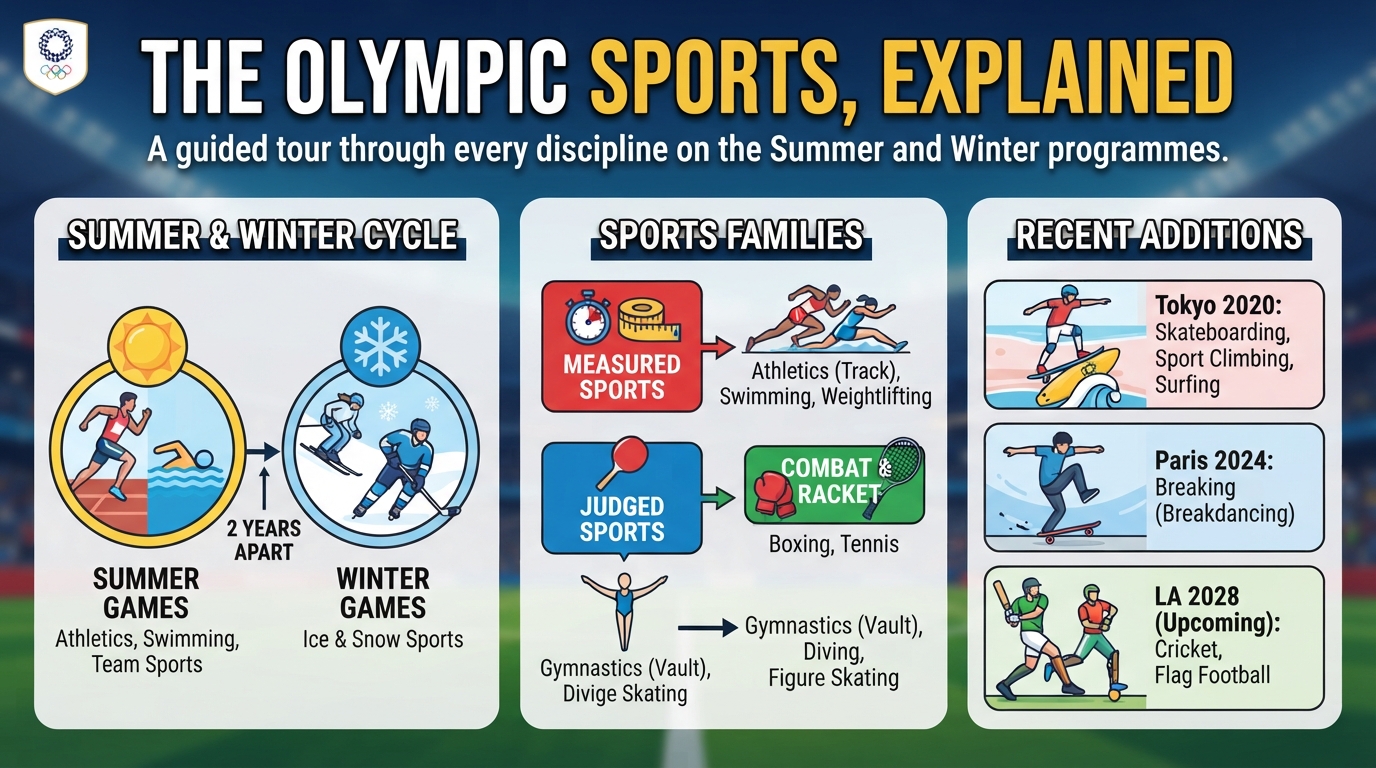
The Summer and Winter Olympics are separate events with entirely different sports programmes, both held every four years but staggered two years apart since 1994 — so there's now a Games roughly every two years instead of both landing in the same year. The Summer programme is built around athletics, swimming, and team sports; the Winter programme is built around ice and snow — skiing, skating, ice hockey, and the like.
How a sport actually gets added
The International Olympic Committee (IOC) decides the core programme, weighing global popularity, gender balance, cost of hosting, and youth appeal. On top of that, each host city can propose "additional" sports specific to their own Games — which is how skateboarding, sport climbing, and surfing debuted at Tokyo 2020, and how breaking joined the programme at Paris 2024. Cricket, flag football, lacrosse, squash, and baseball/softball are set to join for Los Angeles 2028.
Judged vs. measured — a useful way to group sports
It helps to sort Olympic sports into two families. Measured sports have an objective result — fastest time, longest distance, most goals — where athletics, swimming, cycling, and weightlifting all live. Judged sports are scored by panels against a technical standard — gymnastics, diving, figure skating — which is why these are also the sports where scoring controversies get the most attention: the outcome depends on interpretation, not just a stopwatch.
Combat and racket sports (boxing, judo, wrestling, tennis, badminton) sit somewhere in between: head-to-head contests decided by direct scoring or elimination brackets rather than a single measured number.
Most of what Sportoum teaches is Olympic
Of the 30 sports in Sportoum's library, the large majority carry Olympic status — each sport's detail page in the app shows this with a small Olympic badge. If you're building toward watching the Games with real understanding rather than just following the medal count, that's exactly the gap the app's lessons are built to close.
Ready to go deeper?
Download the App